

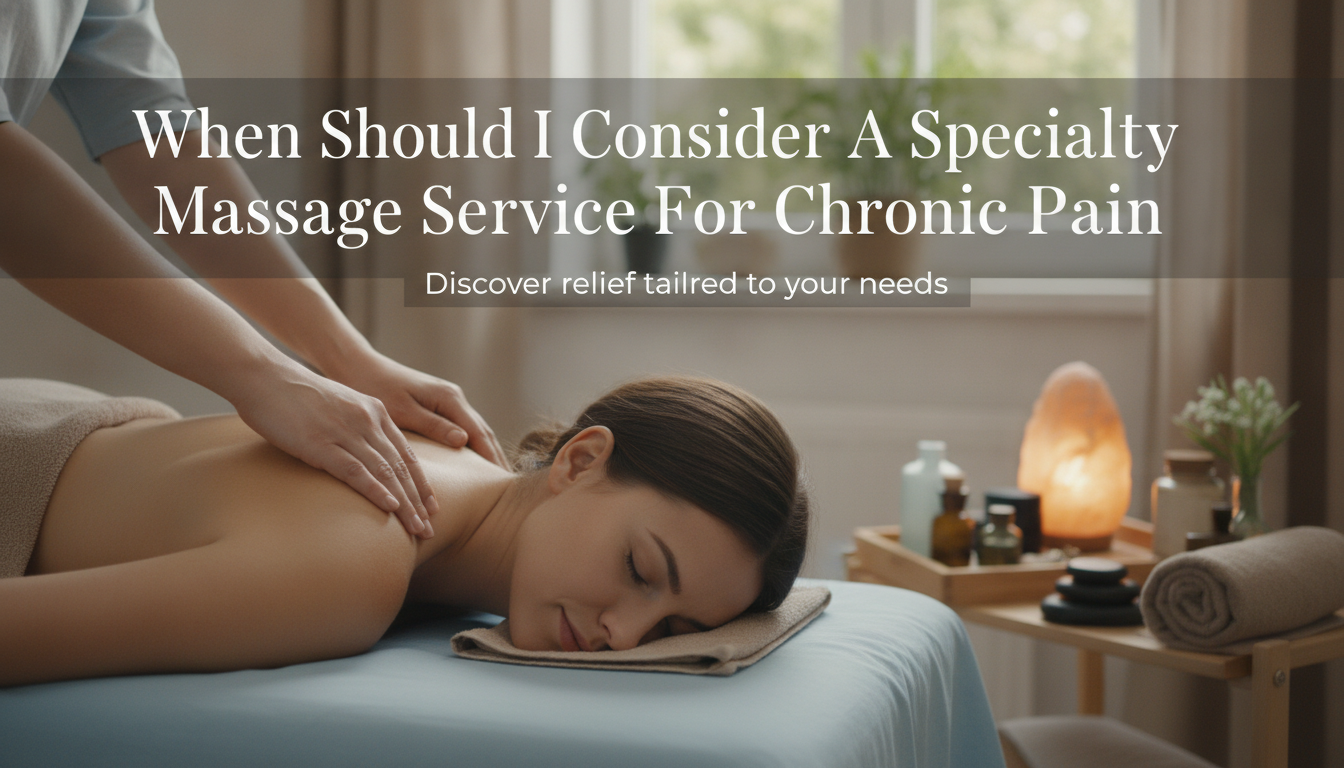
What Is a Deep Tissue Massage and Is It Right for You?
A deep tissue massage is a therapeutic technique that applies sustained, firm pressure to the deeper layers of muscle and connective tissue, targeting chronic tension, postural strain, and adhesions that sit well below the surface. Unlike a relaxation massage, it works methodically through the muscle belly rather than across it, releasing knots that cause restricted movement and persistent aching. If you carry tightness in your neck and shoulders after long hours at a desk, or your lower back has been complaining since your last long drive down Airport Road, deep tissue work addresses the structural cause rather than masking the discomfort.
Why Deep Tissue Massage Is More Than a Firm Rub-Down
The phrase “deep tissue” is sometimes used loosely to mean simply harder pressure, but correct technique is more specific than that. A trained therapist works with slow, deliberate strokes — often with thumbs, forearms, or elbows — angled to follow the direction of muscle fibres rather than against them. The intention is to break down adhesions: dense bands of tissue that form around an injury site or from habitual muscle overuse. These adhesions restrict circulation, limit range of movement, and maintain a low-grade ache that many people simply learn to live with.
Preparation matters too. A good session begins with a consultation in which the therapist assesses your posture, asks about any recent injuries or medical history, and identifies the areas most likely to hold tension before you even lie down on the table. This is not a formality — skipping it risks applying deep pressure to an area that genuinely needs rest, or to one where underlying inflammation would be worsened rather than eased.
Who Benefits Most from Deep Tissue Massage in Abuja?
The short answer: almost anyone who carries sustained physical or postural stress — but the specific picture in Abuja is worth spelling out.
- Civil servants and FCT professionals who spend six to eight hours daily at a workstation, often in chairs that do not support the lumbar spine correctly, accumulate tension across the upper trapezius and into the thoracic spine. By Thursday, the discomfort is real.
- Diplomats and NGO staff travelling frequently — long-haul flights followed by back-to-back meeting schedules — arrive carrying a particular kind of fatigue that sits in the hips and the base of the neck.
- Drivers and commuters who regularly navigate the Kubwa Expressway or the Nyanya corridor know what sustained, low-grade bracing against traffic does to the shoulders and forearms over months.
- Fitness enthusiasts and athletes who train consistently and need deeper recovery work than a standard sports massage delivers.
- People recovering from old, soft-tissue injuries where scar tissue has formed and limited flexibility — though any injury that is still acute, warm, or swollen should be assessed by a doctor before any massage is considered.
It is equally important to be direct about who deep tissue massage is not appropriate for. Active inflammation, blood-clotting disorders, unmanaged high blood pressure, osteoporosis, skin infections, or recent surgery are all contraindications. The consultation at the start of your appointment exists precisely to catch these factors. If there is any doubt, a responsible therapist will refer you to a physician rather than proceed.
How a Deep Tissue Massage Session Actually Unfolds
Understanding the sequence helps you get more out of it and interpret what you feel during and after.
- Consultation (before you lie down): The therapist reviews your intake form, asks about specific pain sites, recent injuries, medication, and your pressure tolerance. This is the moment to be honest — if you had a minor accident three months ago, or if your right shoulder has been clicking, say so now rather than halfway through.
- Warm-up strokes: The session opens with lighter effleurage to warm the superficial tissue and allow your nervous system to settle. Arriving cold at depth causes the muscle to guard, which counteracts the entire purpose.
- Progressive deepening: The therapist gradually increases pressure and slows the stroke cadence. You will feel the work land differently from a relaxation massage — more specific, sometimes mildly uncomfortable at the point where the adhesion releases. This is normal and should feel like a productive discomfort, not sharp pain. If you feel sharp, shooting, or numbing pain, say so immediately.
- Focused work on key areas: Based on your consultation, the therapist will spend time on the identified tension sites — commonly the erector spinae, rhomboids, piriformis, or calves — using sustained pressure, cross-fibre friction, or myofascial release depending on what the tissue requires.
- Finishing strokes: Lighter, integrating effleurage to ease the tissue back, encourage circulation, and prevent the sudden soreness that can follow if the session ends abruptly at depth.
- Post-session guidance: A good therapist will tell you what they found, what to expect in the next 24–48 hours, and when rebooking would be appropriate.
What to Expect After Your Session — A Realistic Aftercare Timeline
Managing post-massage expectations honestly is part of delivering a good service, and it is worth setting out clearly.
First 24 hours: Mild to moderate soreness in the worked areas is entirely normal — sometimes described as the feeling after a challenging workout. Drink water consistently, avoid strenuous exercise, and if you find the area genuinely tender, a warm (not hot) compress for ten to fifteen minutes provides relief. Avoid cold therapy unless your therapist has specifically suggested it.
Days two and three: For most people, the soreness reduces significantly and the sense of release becomes clearer. Range of movement often improves noticeably. Sleep quality sometimes improves in this window as the nervous system downregulates. If you are still experiencing sharp or worsening pain by day three, contact your therapist and, if necessary, a physician.
First week: Continue gentle movement — walking, light stretching — to prevent the tissue from stiffening back into old patterns. This is the period when the results are consolidating.
Four to six weeks: For chronic tension that has built up over months or years, a single session produces results but does not fully resolve the issue. Most therapists recommend a follow-up within four to six weeks, especially for the first few sessions of a new treatment plan. The interval can widen as the tissue responds and holding patterns begin to change.
Deep Tissue Massage During Harmattan and the Rainy Season
Abuja’s climate affects the body in ways that alter both the experience and the benefit of massage more than people expect.
During harmattan — roughly November through February — the Saharan air pulls humidity down sharply. Skin becomes ashy and prone to micro-cracking, and the combination of dry air and heightened muscle tension from the cold mornings means the tissue is often denser and less pliable than it is in June. A therapist who works here knows that warm-up time needs to be longer in December than in August, and that a good hydrating body treatment either preceding or following the massage makes a tangible difference to how the skin responds.
In the rainy season, the opposite challenge appears: high ambient humidity, sweating under clothing and protective wear, and for many clients, the physical fatigue of navigating flooded roads and erratic power supply. The body carries a different kind of tension in April than in January, and session focus may shift accordingly — less stiff, dried-out tissue, more water retention in the lower limbs and generalised fatigue that responds well to the circulatory benefits of sustained massage work.
A Realistic Scenario: A Wednesday Evening Appointment After a Full Week
Imagine a senior civil servant at a ministry in the Central Business District. Her week has involved two full-day meetings, a proposal deadline, and two hours each morning sitting in traffic from Wuse before eight o’clock. By Wednesday evening, the familiar pull between her shoulder blades has settled into something more insistent, and she has been rotating her neck instinctively during meetings. She cannot take a full day off, and she cannot make a Saturday appointment work with the school run and the aso-ebi fittings for next week’s traditional ceremony.
She books a 9pm appointment at the Wuse 2 branch — a ten-minute drive from where she lives — because Luxor is open at 9pm, at 11pm, and at 6am. The flexibility is not a selling point to her; it is the actual reason she can attend at all. The session covers a consultation, a thorough warm-up, and focused work on the trapezius, rhomboids, and the left hip flexor that has been complaining since she started wearing heels to a job that requires standing for Honourable Members. She leaves by 10:45pm. By Friday morning, her neck rotates without the catching sensation. She rebooks for four weeks later.
This is what a 24/7 luxury salon and spa in Abuja makes possible in practice — not an indulgence for unusual schedules, but a professional service fitted around the schedules that actually exist in this city. You can book online at whatever hour the window opens for you.
How Deep Tissue Massage Compares to Other Treatments at Luxor
Swedish Relaxation Massage
Lighter pressure, longer strokes, a strong parasympathetic response. Excellent for general stress, first-time clients, or anyone whose primary need is nervous system downregulation rather than structural release. If you are highly sensitive to pressure or coming in during an acutely stressful period, this may be the better starting point.
Hot Stone Massage
Smooth, heated stones placed on key points and used as an extension of the therapist’s hands. The warmth penetrates tissue faster than manual pressure alone, making it particularly useful in harmattan when the muscle is cold and reluctant. Not a substitute for deep tissue work in chronic tension cases, but a complement to it.
Sports Massage
More specifically targeted to athletic performance, recovery, and injury prevention. Works in a similar depth range to deep tissue but with different techniques — passive and active stretching, compression, trigger-point work on muscle-tendon junctions. If you train consistently or are preparing for an event, this may be more precise for your needs.
Body Wraps and Scrubs
These address the skin layer rather than the muscle tissue and make an excellent pre- or post-massage addition, particularly during harmattan when skin hydration is a genuine concern rather than a luxury preference.
Frequently Asked Questions
Which Luxor branch should I visit for a deep tissue massage?
Both branches — at 56 Usuma Street in Maitama and 792b Adetokunbo Ademola Crescent in Wuse 2 — offer full spa services including deep tissue massage. The practical answer is whichever is closer to where you are coming from. If you work in the embassy belt or live in Asokoro, Maitama will save you time. If you are coming from Wuse, Central Business District, or heading in from the Nyanya corridor, Wuse 2 is the more sensible choice on an evening when you have already sat in traffic once.
Do I need to book in advance, or can I walk in?
Walk-ins are welcome, but for a Saturday appointment or any booking during the December festive season, advance booking is strongly advisable. Demand peaks sharply from mid-November through the Christmas and New Year period, and wait times for preferred time slots grow quickly. Booking even three to four days ahead is usually enough for a weekday; a week or more ahead is safer for weekends and public holidays.
How often should I get a deep tissue massage?
For chronic tension — the kind built up over months of desk work or postural strain — most therapists suggest starting with monthly sessions and adjusting based on how the tissue responds. If you are managing an ongoing condition or training heavily, fortnightly may be more effective in the initial phase. Your therapist will give you a recommendation at the end of your first session based on what they find.
Will a deep tissue massage hurt?
There is often a productive discomfort when pressure lands on a tight adhesion — a sensation that most clients describe as intense but in the right place, different from actual pain. Sharp, shooting, or numbing sensations should be communicated to the therapist immediately so pressure and angle can be adjusted. Post-session soreness for 24–48 hours is normal; it should not be severe or worsen after the first day. If it does, contact the salon and consult a physician if necessary.
Is deep tissue massage suitable during harmattan?
Yes, and in some respects the season increases the benefit — cold, dry air causes muscles to contract and hold more tension than in humid months. The warm-up phase of the session should be longer to allow the tissue to soften before deeper pressure is applied. Pairing the massage with a hydrating body treatment is worth considering, as harmattan-stripped skin responds well to the combination, and many clients find the results more comprehensive when both layers — skin and muscle — are addressed in the same visit.
Getting It Right: Key Takeaways on Deep Tissue Massage
Deep tissue massage works when it is applied correctly — with a proper consultation, a warm-up sequence, calibrated pressure, and honest post-session guidance. It is not the right choice for every body on every day, and a good therapist will tell you so rather than proceed regardless. What makes the difference, beyond technique, is the discipline to assess first and treat second, and to match the treatment to what the tissue actually needs rather than what sounds most intensive.
Luxor Salon and Spa has been doing this work in Abuja since 2013. Whether your schedule fits a lunchtime slot, a pre-dawn appointment before you drive to the airport, or a late evening session after the children are settled, both branches are open to receive you. Choose your side of the city, book ahead if the weekend or December is approaching, and arrive knowing that the consultation at the start of your appointment is where the session is actually decided.
Book your appointment:
Reserve your session at luxorsalonandspa.com — available any hour, any day of the week.
Maitama Branch — 56 Usuma Street, Off Gana Street, Maitama:
moc.apsdnanolasroxul@ofni | (+234) 701 888 0102
Wuse 2 Branch — 792b Adetokunbo Ademola Crescent, Wuse 2:
moc.apsdnanolasroxul@2esuw | (+234) 701 888 0100
Both branches are open 24 hours a day, seven days a week — because an early morning or late-night appointment is not a special request here; it is simply how the booking system works.