

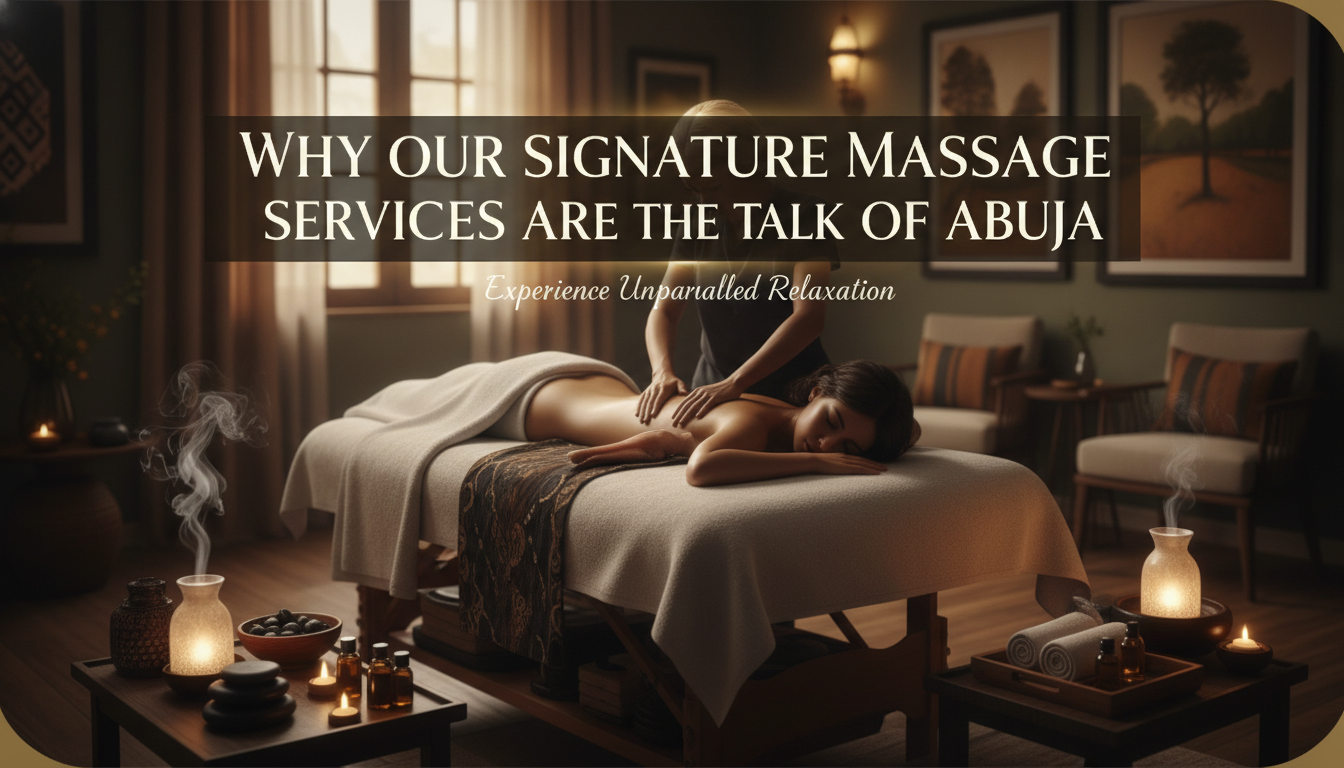
A deep tissue massage in Abuja does exactly what it sounds like: firm, sustained pressure is applied to the deeper layers of muscle and connective tissue to release chronic tension, break up adhesions, and restore proper movement. Unlike a lighter relaxation massage, it specifically targets the muscles beneath the superficial layer — the ones that tighten from long hours at a desk, long drives on Airport Road, or simply the physical toll of a packed Abuja schedule. Results are real, but a single session is rarely enough for long-standing tension; most people notice the biggest shift after two to three sessions spaced a few weeks apart.
What Deep Tissue Massage Actually Does to Your Muscles
The phrase “deep tissue” gets used loosely in a lot of spa menus, so it is worth being specific. A true deep tissue massage works by applying slow, deliberate strokes and direct pressure — sometimes with thumbs, knuckles, or forearms — to reach the deeper muscle fibres and the fascia surrounding them. The goal is not simply to press harder. It is to work methodically through layers of tissue, allowing each layer to release before going deeper.
When a muscle has been held under tension for weeks or months — say, the trapezius and levator scapulae of someone who sits through long Federal Secretariat meetings or hunches over a laptop — fibres can form adhesions sometimes called knots. These adhesions restrict movement, reduce circulation to the area, and often refer pain to seemingly unrelated spots, like the base of the skull or the shoulder blade. Deep tissue work breaks those adhesions down mechanically and encourages fresh blood flow into the tissue.
There is usually some discomfort during the process — a productive ache rather than sharp pain. A skilled therapist will check in with you throughout. If at any point the sensation crosses into sharp or burning pain, that is feedback the therapist needs immediately. Communication is not optional; it is part of the treatment.
Who Benefits Most from a Deep Tissue Massage in Abuja
Desk-bound professionals and civil servants
Sitting for six to eight hours a day creates a predictable pattern of tightness: shortened hip flexors, an overworked lower back, rounded shoulders, and a neck that has been craning forward at a screen. FCT professionals, civil servants, and NGO workers often arrive with exactly this picture. The deep tissue work concentrates on the erector spinae, the rhomboids between the shoulder blades, the neck extensors, and — if the gluteal muscles are involved, which they frequently are — the piriformis that can compress the sciatic nerve.
People carrying event or occasion stress
Abuja’s social calendar is relentless. Between owambe weekends, introduction ceremonies, and the full sprint of the December season when the diaspora returns and every hotel ballroom is booked solid, a significant number of people arrive at Luxor carrying accumulated physical stress that they have simply not had time to address. A deep tissue massage in the days leading up to or following a major event is not a luxury in the abstract sense — it is a practical intervention.
Active and physically demanding lifestyles
This includes people who train regularly, those who stand on their feet for most of the day, and anyone who has recently taken a long-haul flight into Nnamdi Azikiwe International Airport after months abroad. Long-haul travel creates its own pattern of tightness — compressed hip flexors, swollen ankles, and a spine that has been held in a slightly flexed position for hours.
People managing harmattan-season stiffness
From roughly November through February, Abuja’s humidity drops sharply as Saharan dust rolls in. Most people associate harmattan with dry skin and brittle hair, but the cold, dry air also tends to make muscles feel stiffer — particularly first thing in the morning. People with chronic back or neck tension often report that it worsens noticeably between December and February. This is a real phenomenon: dehydration affects muscle tissue as well as skin, and reduced ambient humidity means the body loses moisture faster. A deep tissue session during this period pairs well with proper hydration in the days before and after.
What to Expect at Your First Session at Luxor
The consultation
Before any hands-on work begins, your therapist will take a brief history — current areas of tension or pain, any recent injuries, medical conditions that might affect how the treatment is delivered, and what you are hoping to achieve. This matters. Certain conditions, including active inflammation, recent fractures, blood clotting disorders, and some skin infections, require the session to be modified or postponed. The consultation is not a formality; it is how the treatment is made safe and relevant for your body specifically.
If you have a particular injury — a recurring left shoulder issue, for example, or lower back pain that appeared six months ago and never fully resolved — be specific about when it started, what makes it better or worse, and whether you have seen a doctor about it. Persistent unexplained pain or pain that is worsening should always be assessed by a physician or physiotherapist before a deep tissue massage, and your therapist will tell you the same. Luxor’s therapists are trained in bodywork, not diagnosis.
The session itself
You will be draped throughout the session — only the area being worked is uncovered at any given time. The therapist typically begins with lighter effleurage strokes to warm the tissue and assess where tension is concentrated, then progresses gradually to deeper work. Massage oil or cream is applied to reduce friction and allow the strokes to glide smoothly. You will likely be asked at intervals whether the pressure is appropriate.
Deep tissue work on areas of significant tension can feel intense. Most clients describe it as “hurts but good” — a relief-tinged discomfort that is clearly productive. If anything feels wrong — sharp, shooting, or genuinely painful — say so immediately. A good therapist adjusts without making you feel that you are being difficult.
After the session: what the next 72 hours look like
- First 24 hours: Drink more water than usual. The mechanical work on muscle tissue releases metabolic waste products into circulation, and hydration helps your body clear them efficiently. Some mild soreness — similar to the feeling after a new workout — is normal and usually peaks around 24 hours after the session.
- Day two: The soreness typically begins to ease. Many clients notice that the area that felt tight before the session is now looser and more mobile than it has been in months. A warm shower or warm compress can ease any residual tenderness.
- Days three to five: This is when most people feel the full benefit — reduced tension, improved range of movement, better posture, and often a noticeable improvement in sleep quality.
- Week two to three: If the tension was long-standing, it may begin to creep back as the muscle memory reasserts itself. This is normal, and it is the reason a course of sessions is usually more effective than a single one.
- Four to six weeks: A good window for a follow-up session if you are working on a chronic issue. For general maintenance, many Abuja clients working demanding schedules find a monthly session keeps things manageable without the tension building back to crisis point.
A Realistic Scenario: The Wuse 2 Professional on a Wednesday Evening
Consider Ngozi, a procurement officer whose office is on Adetokunbo Ademola Crescent. She has been carrying tension in her right shoulder since a difficult contract negotiation three weeks ago. By the time she books her session, the tightness has started affecting her sleep. She cannot get a Saturday appointment easily because that slot fills quickly during Abuja’s event season.
At 7pm on a Wednesday — after the Wuse 2 traffic has thinned enough to be bearable — she walks into Luxor’s Wuse 2 branch, which is less than a ten-minute drive from her office. The consultation takes about ten minutes. The deep tissue work focuses on her upper trapezius, neck extensors, and the rhomboid area between her right shoulder blade and spine. By 8:30pm she is done, slightly tender in that productive way, and on her way home.
She wakes up on Thursday with expected soreness. By Friday afternoon, the shoulder is noticeably looser. She books a follow-up for three weeks later, this time at 9am before her first meeting. This is precisely what Luxor’s 24/7 operating hours are built around — not the idea that clients want a 3am massage, but the reality that in Abuja, neither 7pm nor 6am is an unusual working hour.
If her schedule takes her to the Maitama side of the city, the branch on Usuma Street is equally convenient — particularly for clients based near the embassy belt or the Diplomatic Drive axis, who would otherwise face the full cross-city run in peak-hour traffic.
Building a Massage Schedule That Actually Works
One of the most common mistakes people make with deep tissue massage is treating it as a one-off crisis response — booking a session only when the pain becomes impossible to ignore, getting some relief, and then forgetting about it until the next crisis. That pattern means you spend most of the session just undoing acute tension rather than making progress on the underlying issue.
A more practical approach, particularly for people dealing with chronic desk-related tension:
- First month: Two sessions spaced two to three weeks apart, to begin breaking down long-standing adhesions and establishing a baseline.
- Second and third month: One session per month, consolidating the gains and preventing significant re-accumulation.
- Maintenance phase: Monthly or every six weeks, depending on your work pattern and physical activity level. During harmattan, when stiffness tends to worsen, some clients find they want to reduce the gap slightly.
If you are preparing for a major event — a wedding, a significant ceremony, a work trip that involves long-haul travel — build the schedule backwards. A deep tissue session two to three days before travel, for example, allows the mild post-session soreness to pass before you are in transit. For a bride, a session at roughly the two-week mark before the ceremony (not the night before — you want the soreness window to have passed) is sensible.
Ready to start? You can book online at whichever branch suits your location and choose a time that fits around your actual schedule — including early morning or late evening appointments.
Deep Tissue Massage and Skin: What to Tell Your Therapist
The oils and creams used in massage are applied directly to the skin, so this is not a trivial consideration — especially for clients with melanin-rich skin that is prone to post-inflammatory hyperpigmentation or sensitivity. If you have any known skin sensitivities, active rashes, eczema flares, or areas of broken skin, mention them during the consultation. A reputable salon will only use products that meet NAFDAC registration standards for cosmetic use; unregistered topical products are a genuine risk in the Nigerian market, and Luxor’s standards require that products used on clients are properly certified.
During harmattan specifically, skin can be significantly drier and more prone to sensitivity than during the rainy season. If your skin is flaking or cracked — particularly at the elbows, knees, or heels — let your therapist know. The product selection and pressure applied to these areas can be adjusted accordingly.
Hygiene Protocols: What Should Happen Before the Therapist Touches You
In any professional massage setting, hygiene is non-negotiable. The treatment table should be freshly covered for each client. The therapist’s hands should be washed. Any tools used in the session — hot stones, for example, or cups if cupping is combined with the massage — should have been properly cleaned and disinfected between clients. These are not matters of preference; they are infection control basics.
At Luxor, therapists are trained and certified, and the protocols for client safety are consistent across both branches. If you are ever unsure about hygiene standards at any salon or spa — Luxor’s or anyone else’s — it is entirely reasonable to ask. A reputable establishment will answer without hesitation.
Frequently Asked Questions
Which Luxor branch should I visit for a deep tissue massage in Abuja?
Choose the branch closest to where you will be travelling from. The Wuse 2 branch on Adetokunbo Ademola Crescent is more convenient for clients on the commercial side of the city — particularly if you are coming from work in central Abuja or the Wuse axis. The Maitama branch on Usuma Street suits clients coming from the embassy belt, the Asokoro corridor, or the northern residential districts. Both branches offer the full range of massage services and operate 24/7, so availability is not a reason to choose one over the other.
Do I need to book in advance, or can I walk in?
Walk-ins are accommodated where a therapist is available, but deep tissue massage requires a skilled practitioner and some preparation, so booking in advance is strongly recommended — particularly for Saturday appointments or any slot falling in the December peak season. For popular evening windows (roughly 6pm to 9pm on weekdays), a day or two of notice is wise. Early morning and late-night appointments, which 24/7 access makes possible, tend to have more flexibility.
How long does a deep tissue massage session typically last?
Sessions typically run between 60 and 90 minutes, depending on the areas being treated. A full-body deep tissue session generally needs at least 75 to 90 minutes to be done properly; a targeted session focusing on the upper back, neck, and shoulders can be effective in 60 minutes. Your therapist will discuss this during the consultation and may adjust based on what they find in the tissue.
Is deep tissue massage suitable during harmattan?
Yes, and for many clients it is especially useful during the November-to-February period when muscle stiffness tends to increase with the cold, dry air. The main adjustment is hydration — drink more water than usual in the 24 hours before and after your session, as dehydrated muscle tissue takes longer to respond and recover. Mention any skin sensitivity or dryness during the consultation so the therapist can choose products accordingly.
How soon will I feel the results?
Many clients notice an immediate improvement in mobility and a reduction in the sensation of tightness after their first session, even accounting for the mild post-session soreness that typically peaks around 24 hours later. For chronic tension that has been building for months, the most significant and lasting results usually come after two or three sessions. Managing expectations honestly matters here: one session provides real relief, but it is rarely the end of the story for long-standing issues.
Making the Most of Your Deep Tissue Massage Experience
Deep tissue massage is one of the more evidence-supported bodywork interventions available — useful for chronic muscle tension, limited range of motion, and the kind of accumulated physical stress that Abuja’s professional pace reliably generates. It is not a medical treatment, and a therapist is not a physiotherapist or a doctor. But for the specific problem of tight, knotted, overworked muscle tissue, it is genuinely effective when delivered well and followed up sensibly.
Luxor has been operating in Abuja since 2013, which means the team has worked through many harmattan seasons, many December rushes, and many clients who initially came in sceptical and became regulars. That experience matters. The combination of trained therapists, properly certified products, and hours that accommodate a real Abuja schedule — not an idealised one — is what makes the difference between a session that helps and one that does not.
Both branches are ready to see you whenever your schedule allows. Schedule your appointment online at any hour — early, late, or weekend — or reach out directly to the branch closer to you:
Maitama — 56 Usuma Street, Off Gana Street, Maitama, Abuja:
moc.apsdnanolasroxul@ofni or (+234) 701 888 0102
Wuse 2 — 792b Adetokunbo Ademola Crescent, Wuse 2, Abuja:
moc.apsdnanolasroxul@2esuw or (+234) 701 888 0100
Both branches are open 24 hours a day, seven days a week. A 6am slot before the morning commute and a 10pm slot after an evening event are both genuinely available — because that is what Abuja’s schedule actually looks like.
Related Posts
 Which Wellness Services Focuses Primarily On Detoxing The Body
 Why Our 7 Signature Massage Services Are Always Fully Booked
 7 Reasons Our Signature Manicure Services Is Highly Addictive
 Why Choosing Luxor Spa Means Choosing Quality Manicure Services
 What Wellness Services Are Ideal For Busy Professionals In Abuja
 Why Is Our Signature Massage Services Considered World Class
 7 Reasons Why Our Facials Services Stand Out Among Abuja Spas
 Why Our Signature Hot Stone Massage Services Is Highly Recommended