

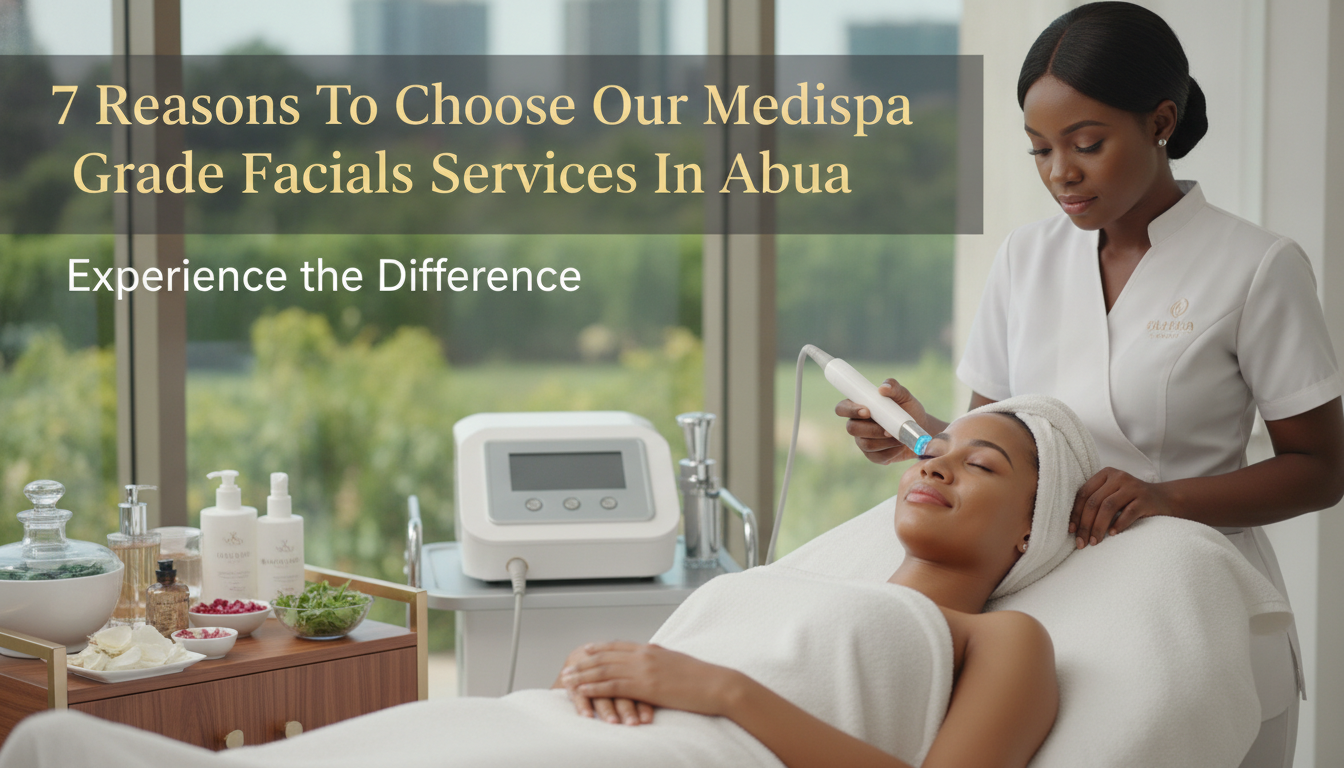
A professional facial in Abuja does more than cleanse your skin — it delivers a structured, therapist-led treatment that assesses your skin type, addresses specific concerns such as hyperpigmentation, dehydration, or uneven texture, and uses targeted actives in the correct sequence. At a professional standard, a facial typically runs between 60 and 90 minutes and includes double cleanse, exfoliation, extractions where needed, a treatment mask, and a finishing moisturiser with SPF. The difference between a home routine and a professional facial is not just the products — it is the trained eye reading your skin before anything touches your face.
Why Abuja Skin Needs a Facial More Than You Think
Abuja’s climate is not gentle. Between November and February, harmattan strips the atmosphere of humidity and replaces it with fine Saharan dust that settles on skin, clogs pores, and accelerates transepidermal water loss. You will notice it first in the tightness around your cheeks and the ashy look that no amount of lotion seems to fix. Your rainy-season routine — the lighter moisturiser, the gel cleanser, the serum that felt like enough — is not built for this.
Then the rains return, and the equation flips. High humidity from April through October brings sweat, sebum, and product build-up, particularly for anyone wearing a wig, frontal, or full protective style all week. The scalp and the skin of the face are dealing with different problems, but both are dealing with something. A professional facial gives your skin the reset it cannot give itself.
Melanin-Rich Skin and Why Technique Matters
For darker skin tones — which describes the overwhelming majority of Luxor’s clients — certain facial decisions carry more weight. Post-inflammatory hyperpigmentation (PIH) develops quickly after any inflammatory event: a bad extraction, an aggressive peel, or even friction from a face cloth. Keloid-prone skin responds differently to certain actives. A therapist who understands these dynamics will choose enzyme exfoliation over a high-strength acid peel for a first session, or will adjust extraction technique to avoid triggering a flare.
This is not a niche concern — it is the standard that any reputable salon in Abuja should be practising. At Luxor, consultations before any facial involving chemical actives are non-negotiable. If your skin presents signs that go beyond cosmetic — persistent cystic breakouts, suspected infection, unusual pigmentation patterns — you will be advised to see a dermatologist first, and that recommendation will be made clearly.
What Actually Happens During a Professional Facial at Luxor?
Understanding the sequence helps you know what you are paying for and sets realistic expectations before you sit in the chair.
Step 1: Skin Consultation
Your therapist begins by asking about your current skincare routine, any known sensitivities, recent treatments, and what you are hoping to achieve. This is not small talk — it determines everything that follows. Someone coming in during harmattan with dehydrated, dull skin will receive a very different treatment from someone dealing with oiliness and congestion in the rainy season.
Step 2: Double Cleanse
The first cleanse removes makeup, SPF, and surface debris. The second cleanse works on the skin itself, clearing sebum and environmental residue from the day. This two-stage process ensures that whatever is applied next — serum, acid, mask — is actually reaching the skin rather than sitting on top of a layer of product.
Step 3: Exfoliation
Depending on your skin type and sensitivity, your therapist will use either a physical exfoliant or a chemical exfoliant — enzymes, lactic acid, or a gentle AHA — to remove dead skin cells and begin brightening the surface. For first-time clients or those with melanin-rich skin that is easily sensitised, the approach will typically be conservative and then adjusted over subsequent sessions.
Step 4: Steam and Extractions
Controlled steam softens the follicle walls, making extractions more effective and less traumatic. Your therapist performs extractions on blackheads and milia where appropriate, using gloved hands and proper technique. Aggressive or unsupervised extractions are one of the most common causes of PIH in darker skin tones — this step should never feel violent.
Step 5: Treatment Mask
The mask is chosen for your assessed skin concern: hydrating, purifying, brightening, or calming. This is where the active ingredient work happens, and where the cabin environment — temperature, quiet, no phone — actually helps by letting you relax enough for circulation to support absorption.
Step 6: Serum, Moisturiser, and SPF
The treatment closes with layers that seal in what has been delivered. SPF is applied as a final step during the day — not optional, not an afterthought. Exfoliated skin is temporarily more photosensitive, and unprotected exposure directly after a facial can trigger the very hyperpigmentation the treatment was meant to address.
Facial Aftercare: What to Do in the First Week
What you do after a professional facial matters almost as much as the treatment itself. Follow this sequence to protect your results.
- First 24 hours: Avoid makeup if possible. Do not use active products — retinoids, vitamin C serums, AHAs — at home on the same evening. Cleanse gently with lukewarm water only. Drink water consistently; your skin has just been through a process that demands internal hydration support.
- Days 2–3: You may notice mild peeling or purging, particularly after your first facial or an exfoliating treatment. This is normal and temporary. Do not pick. Use a gentle, fragrance-free moisturiser and apply SPF every morning.
- Days 4–7: Your skin should begin to look noticeably cleaner, brighter, and more even in tone. Resume your active serums gradually — one at a time, not all at once.
- Weeks 3–4 rebooking window: For maintenance, most therapists recommend a facial every four to six weeks. This aligns with the skin’s natural cell turnover cycle. During harmattan or in the lead-up to a major event, you may want to come in closer to every three to four weeks.
Planning Your Facials Around Abuja’s Calendar
Abuja’s social calendar creates predictable demand at any decent beauty salon. The December returnee season, Sallah celebrations, Christmas and New Year parties, and the back-to-back introduction and traditional wedding ceremonies that run from October through March — all of these create a peak in appointment demand. If you have an event in December, do not book your first facial in November and expect the same result as someone who has been on a consistent schedule since October.
A Realistic Facial Schedule for an Upcoming Event or Wedding
- 8 weeks before: First facial — assessment, baseline treatment, identification of key concerns (congestion, dullness, uneven tone). Your therapist builds a protocol.
- 4–5 weeks before: Second session — often the most active treatment in the series, as the skin has been prepped and the therapist can now push further safely.
- 2 weeks before: Third session — consolidation treatment. No harsh exfoliation or new actives at this stage. The goal is to stabilise and brighten.
- Day before the event: A gentle, hydrating facial only. Nothing exfoliating. Your skin should be calm and luminous, not reactive.
This is the kind of timeline a bride preparing for her white wedding or traditional ceremony should plan around. Aso-ebi coordination, venue decoration, and owanbe logistics are stressful enough — your skin should not be a variable you are managing at the last minute. If you are at that eight-week mark now, book online and start the conversation with one of the therapists at whichever branch is closer to you.
Facials and Skin Lightening: What to Know Before You Sit Down
Skin brightening is one of the most requested outcomes from a professional facial in Abuja, and it deserves an honest conversation. There is a meaningful difference between brightening — improving radiance, reducing dullness, addressing PIH — and lightening, which involves altering your natural skin tone. A professional facial achieves the former through exfoliation, vitamin C, niacinamide, and consistent care. The latter often involves high-concentration hydroquinone or ingredients that, in unregulated formulations, can cause irreversible damage.
NAFDAC regulates cosmetic and skincare products sold in Nigeria, and unregistered products carrying undisclosed mercury or banned hydroquinone concentrations remain a documented problem in the market. Luxor uses products with verifiable ingredient transparency. If you are unsure about a product being used on your skin, you have every right to ask — and a professional therapist will tell you exactly what is in the formulation and why it is appropriate for your skin type.
Why a 24/7 Salon Actually Changes Your Skincare Behaviour
Here is a scenario that plays out regularly: a civil servant or FCT professional has a 7am meeting on Maitama’s embassy belt, a full day of back-to-back sessions, and Friday evening traffic on the Kubwa Expressway that makes a 6pm appointment a fiction. The window that actually works is either 6am before work or 9pm after dinner. A salon that is open only until 7pm is, for this person, effectively closed.
Luxor’s 24/7 hours at both branches are not a novelty — they are the practical answer to how Abuja professionals actually live. The Maitama branch on Usuma Street, off Gana Street, puts a facial on the route for anyone working near the embassy belt. The Wuse 2 branch on Adetokunbo Ademola Crescent is in the commercial hub, accessible from the AYA and Nyanya axis or the central districts without going deep into traffic. The point is not to have two locations — it is to make sure one of them is never genuinely inconvenient for you.
Frequently Asked Questions About Professional Facials in Abuja
Which Luxor branch should I visit for a facial?
Both branches offer the same standard of treatment. Choose based on proximity: the Maitama branch on Usuma Street suits clients coming from the embassy belt, Asokoro, or Maitama itself; the Wuse 2 branch on Adetokunbo Ademola Crescent is more convenient if you are based in or travelling through the central commercial areas. Both are open 24 hours, so you can book at whatever time works around your schedule rather than theirs.
Do I need to book in advance, especially on weekends?
Yes — particularly for Saturday appointments and during peak periods like December, Sallah, and owanbe season. Walk-ins are accommodated where possible, but a facial slot, especially a 60-to-90-minute one, is harder to fit spontaneously than a quick blow-dry. Booking in advance also gives the therapist time to prepare for any specific skin concerns you have raised.
How often should I get a professional facial?
The standard recommendation is every four to six weeks, which aligns with your skin’s natural cell turnover cycle. During harmattan, when the climate is particularly harsh, or in the build-up to a major event, moving closer to a four-week schedule will protect the consistency of your results. A one-off facial before a wedding is better than nothing, but a planned series delivers noticeably better outcomes.
Is a professional facial safe for dark skin tones and hyperpigmentation-prone skin?
Yes, when performed by a trained therapist who understands the specific risks of PIH and keloid-prone healing in melanin-rich skin. The key variables are the choice of exfoliant, the pressure used during extractions, and the actives selected for the treatment mask. Your therapist should assess these in consultation before beginning — and if yours does not, ask the question yourself. Patch testing before any treatment involving new actives is standard practice.
Can I get a facial during harmattan even if my skin is already dry and flaking?
Not only can you — it is probably the best time to come in. A hydrating facial delivers controlled moisture and removes the layer of dead, dehydrated cells that prevents your at-home products from penetrating. Your moisturiser works better on skin that has been properly treated than on skin that has been compensating for harmattan dryness through your usual routine alone. Just avoid any aggressive exfoliating treatments on severely compromised or cracked skin, and let your therapist guide the approach.
Conclusion: Consistent Care, Not One-Off Fixes
A professional facial in Abuja is most effective when it is part of a considered routine rather than a reactive treat. Whether you are managing harmattan-induced dryness, maintaining your skin ahead of a busy social season, or addressing hyperpigmentation that your home routine has not shifted, the outcome depends on consistency, the right treatment sequence, and a therapist who actually looks at your skin before deciding what it needs. Luxor has been doing this since 2013 — across two branches, at any hour — because the people who live and work in Abuja deserve skincare that fits their actual lives, not the other way around.
Both branches are open around the clock, which means a 6am appointment before work, a lunchtime visit, or a 10pm slot after an evening event are all genuinely available to you. Choose whichever branch is on your side of the city and go from there.
Book your appointment: book online
Maitama Branch — 56 Usuma Street, Off Gana Street: moc.apsdnanolasroxul@ofni or (+234) 701 888 0102
Wuse 2 Branch — 792b Adetokunbo Ademola Crescent: moc.apsdnanolasroxul@2esuw or (+234) 701 888 0100
Related Posts
 Which Facials Services Should I Choose For Maximum Hydration
 What Are The Essential Anti Aging Steps In Our Premium Facials Services
 How To Choose The Right Sunscreen After Your Facials Services
 When Should I Avoid Getting A Facials Services Before A Big Event
 What Advanced Technology Is Used In Our Facials Services
 7 Reasons Why Our Facials Services Stand Out Among Abuja Spas
 Why Our Advanced Facials Services Use Only Organic Products
 Why Our Facials Services Are Designed For All Abuja Skin Types