
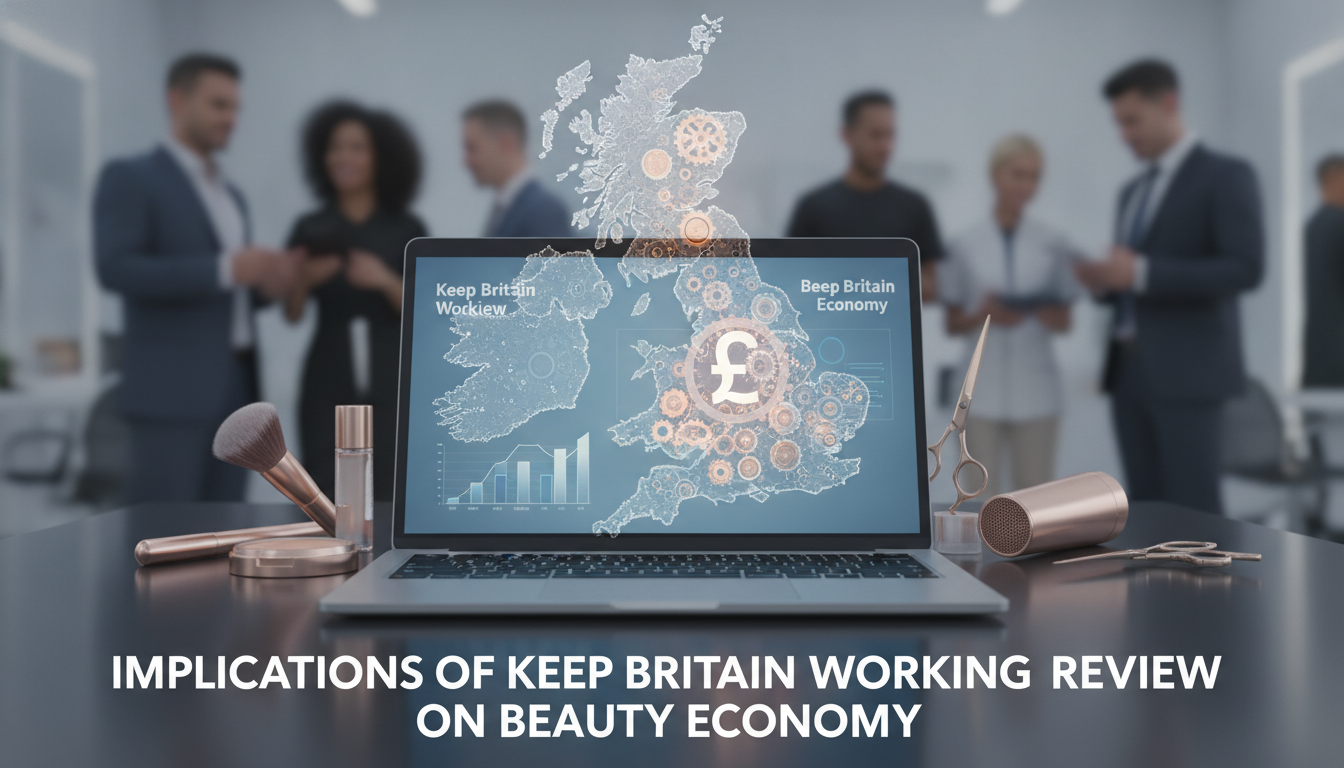
What the Keep Britain Working Review Means for the Beauty Economy
The Keep Britain Working Review, led by Sir Charlie Mayfield and commissioned by the UK Government, directly addresses how businesses — including those in the beauty and personal care sector — can better support employees with health conditions and disabilities to remain in or return to work. For the beauty economy specifically, the review carries significant implications: it frames salons, spas, barbershops, nail studios, and related businesses not merely as lifestyle services but as workplaces where occupational health, workforce retention, and employer responsibility are live issues. The review challenges beauty businesses to rethink how they manage staff wellbeing, adjust working conditions, and engage with occupational health frameworks — many of which the beauty industry has historically operated outside of.
The Beauty Industry as an Employer Under Review
The UK beauty economy employs hundreds of thousands of people, from employed therapists to self-employed freelancers renting chairs in salons. Despite its size, the sector has rarely featured prominently in occupational health conversations. The Keep Britain Working Review changes that framing by calling on all employers — regardless of sector size — to take active responsibility for the health of their workforce.
Beauty workers face a distinct set of physical and mental health challenges: prolonged standing, repetitive strain from waxing, threading, and massage, chemical exposure from dyes and acrylics, and irregular hours. The review’s recommendations, if implemented through government policy, would require beauty employers to engage more formally with these risks rather than treating them as inherent to the job.
Self-Employment and the Gap in Protection
A major structural issue the review highlights is the gap between employed and self-employed workers. In the beauty sector, a large proportion of practitioners operate on a self-employed or freelance basis. The Keep Britain Working Review acknowledges that these workers often fall outside traditional occupational health support structures, leaving them without the kind of early intervention and workplace adjustments that employed workers might access.
This is particularly relevant to the beauty economy because conditions like contact dermatitis — caused by repeated exposure to chemical products — musculoskeletal disorders from prolonged posture, and anxiety or burnout from client-facing work are common in the sector yet rarely formally managed. The review pushes for a broader definition of employer responsibility that encompasses those who set the conditions under which self-employed workers operate, even where there is no direct employment contract.
Occupational Health Access and the Small Business Problem
The vast majority of beauty businesses in the UK are small or micro-businesses — a single salon with two to five staff members, or a solo practitioner. The Keep Britain Working Review directly acknowledges that small and medium-sized enterprises (SMEs) have the least access to occupational health services, often because of cost, lack of awareness, or simply because existing services are designed around larger corporate structures.
For the beauty economy, this is a central tension. The review proposes government-backed support to make occupational health more accessible to SMEs, which could mean subsidised access to advice services, clearer guidance for employers on how to manage long-term health conditions among staff, and better integration between NHS health services and workplace support.
What Practical Change Could Look Like for a Beauty Business
If the recommendations of the Keep Britain Working Review are translated into regulation or expanded incentive schemes, beauty business owners could expect to engage with:
- Formal return-to-work protocols for therapists recovering from conditions like repetitive strain injury or surgery
- Reasonable adjustments frameworks — for example, allowing a nail technician with a back condition to use a posture-adjusted workstation
- Access to subsidised occupational health assessments that evaluate whether a beauty worker’s environment is contributing to their health condition
- Mental health support referral pathways for staff experiencing burnout or anxiety linked to customer service pressures
These are not abstract policy ideas. They represent a potential shift in what it means to run a compliant, responsible beauty business in the United Kingdom.
Workforce Retention in the Beauty Economy
One of the central arguments of the Keep Britain Working Review is economic: when workers with health conditions leave employment unnecessarily, the cost to individuals, businesses, and the state is significant. For the beauty economy, workforce retention is already a challenge. Training skilled therapists, nail technicians, and stylists takes time and investment. Losing a trained member of staff to a preventable or manageable health condition — and then having to recruit and retrain a replacement — is costly.
The review’s emphasis on early intervention is particularly relevant here. Rather than waiting until a beauty worker’s physical condition deteriorates to the point where they can no longer perform their role, the review encourages a proactive model where health issues are identified and addressed early, with adjustments made to allow continued working where possible.
Chemical Exposure and Skin Conditions
Occupational skin disease is one of the most prevalent health conditions among beauty workers. Contact dermatitis caused by repeated exposure to hair dye, bleach, acrylics, and cleaning agents is a known occupational risk. Under the framework suggested by the Keep Britain Working Review, beauty employers would have a stronger obligation to manage these risks not just through personal protective equipment but through formal health monitoring and early referral.
If a beauty therapist or technician develops a skin condition that you believe is linked to products used in your workplace, it is important to seek assessment from a dermatologist with experience in occupational skin disease. A general salon manager or colleague is not equipped to diagnose or manage this — professional medical guidance is essential before returning to full duties.
Implications for the Wider Beauty Economy Beyond the UK
While the Keep Britain Working Review is a UK government initiative, its implications resonate across the global beauty economy, including in growing markets such as Nigeria. As beauty businesses in cities like Abuja professionalise and expand their workforce, questions of occupational health, staff retention, and employer responsibility become increasingly relevant.
At Luxor Salon and Spa, a luxury salon and spa based in Abuja with branches in Maitama and Wuse 2, operating on a 24/7 basis means managing staff across extended hours — a model that brings its own workforce wellbeing considerations. The kind of structured thinking the Keep Britain Working Review encourages around employee health and workplace conditions is directly applicable to businesses operating at this level of service intensity.
During Abuja’s harmattan season, when dry air and dust affect both clients and workers, and during the rainy season when humidity increases, beauty workers face environmental conditions that compound occupational health risks. Thoughtful workforce management during these periods — the kind of proactive approach the review advocates — protects both staff and service quality.
The Policy Landscape and What Beauty Businesses Should Watch
The Keep Britain Working Review is not yet fully enacted legislation, but it signals a clear direction of travel for UK policy. Beauty businesses should monitor developments in several areas:
- Occupational health voucher schemes or subsidies for SMEs, which could make professional health assessment affordable for small salons
- Changes to Statutory Sick Pay rules and return-to-work incentives, which the review recommends reforming to reduce barriers for small employers
- Expanded fit note guidance that could give GPs and occupational health professionals more tools to recommend adjusted duties rather than full absence — directly relevant to beauty workers with physical conditions
- Employer liability considerations if occupational health obligations are strengthened and beauty businesses have not taken steps to manage known risks
What Beauty Business Owners Should Do Now
Regardless of where final legislation lands, the Keep Britain Working Review gives beauty business owners clear direction on best practice:
- Conduct a basic occupational health review of your salon or spa environment, particularly in relation to chemical exposure, posture, and working hours
- Create or update return-to-work policies so that staff recovering from injury or illness have a structured pathway back rather than an abrupt return or prolonged absence
- Identify low-cost or free occupational health resources available through ACAS, the Health and Safety Executive, or sector bodies
- Consider how your self-employed contractors are supported — the review’s direction suggests this responsibility will not remain solely with the individual
Frequently Asked Questions
What is the Keep Britain Working Review and why does it affect the beauty industry?
The Keep Britain Working Review is a UK Government-commissioned review led by Sir Charlie Mayfield examining how employers can better support workers with health conditions to remain in employment. It affects the beauty industry because beauty businesses are employers — and in many cases operate with self-employed workers — who fall within the scope of its recommendations on occupational health, workforce retention, and workplace adjustments.
Does the review only apply to large businesses?
No. One of the review’s specific focuses is making occupational health support accessible to small and micro businesses, which make up the majority of the beauty sector. The recommendations explicitly address the gap in support that SMEs currently experience.
How does the review affect self-employed beauty therapists and freelancers?
The review acknowledges that self-employed workers are often outside traditional occupational health frameworks. It signals a shift towards holding those who set the conditions of work — including salon owners and spa managers — responsible for the health environment they create, even where workers are technically self-employed.
What should a beauty business owner do if a staff member develops a health condition linked to their work?
The first step is to take the concern seriously and not assume the worker simply needs time off. The review encourages early intervention and reasonable adjustments. For conditions like occupational skin disease, refer the worker to a dermatologist with occupational health experience. Document the steps you have taken and seek guidance from ACAS or your sector association.
Can beauty businesses outside the UK, such as those in Nigeria, apply these principles?
Yes. While the review is a UK policy document, its principles around workforce health, occupational risk management, and staff retention are universally applicable. Businesses like Luxor Salon and Spa in Abuja, which operate at a professional and luxury level, can apply this framework to build stronger, more sustainable workforce practices. If you would like to book online, Luxor offers accessible scheduling across both Abuja branches.
Conclusion
The Keep Britain Working Review represents a meaningful shift in how the UK government expects employers — including those in the beauty economy — to engage with occupational health. For beauty businesses, the implications are practical: greater responsibility for staff and contractor health, an expectation of early intervention rather than reactive management, and a clearer framework for supporting workers with health conditions to remain employed. As policy develops, beauty business owners should engage with these changes proactively rather than waiting for legislative compulsion. The principles apply equally to any professional beauty business that takes its workforce seriously — whether operating in London or Abuja.
Luxor Salon and Spa — Maitama Branch:
Email: moc.apsdnanolasroxul@ofni
Phone: (+234) 701 888 0102
Luxor Salon and Spa — Wuse 2 Branch:
Email: moc.apsdnanolasroxul@2esuw
Phone: (+234) 701 888 0100
Related Posts
 Leveraging Influencers for Business Growth in Beauty Sector
 Enhancing Beauty Routines: Lash
 Hair Innovations
 Top 10 Beauty Products on TikTok Shop Livestream Nigeria
 Revieveʼs BeautyCatalyst: How Connected Intelligence is Redefining Beauty
 When To Book A Full Day Of Massage Services And Beauty Treatments
 The 5 Step Harmattan Skincare Routine Every Abuja Resident Needs
 The Best Pre-Wedding Beauty Timeline for Nigerian Brides